
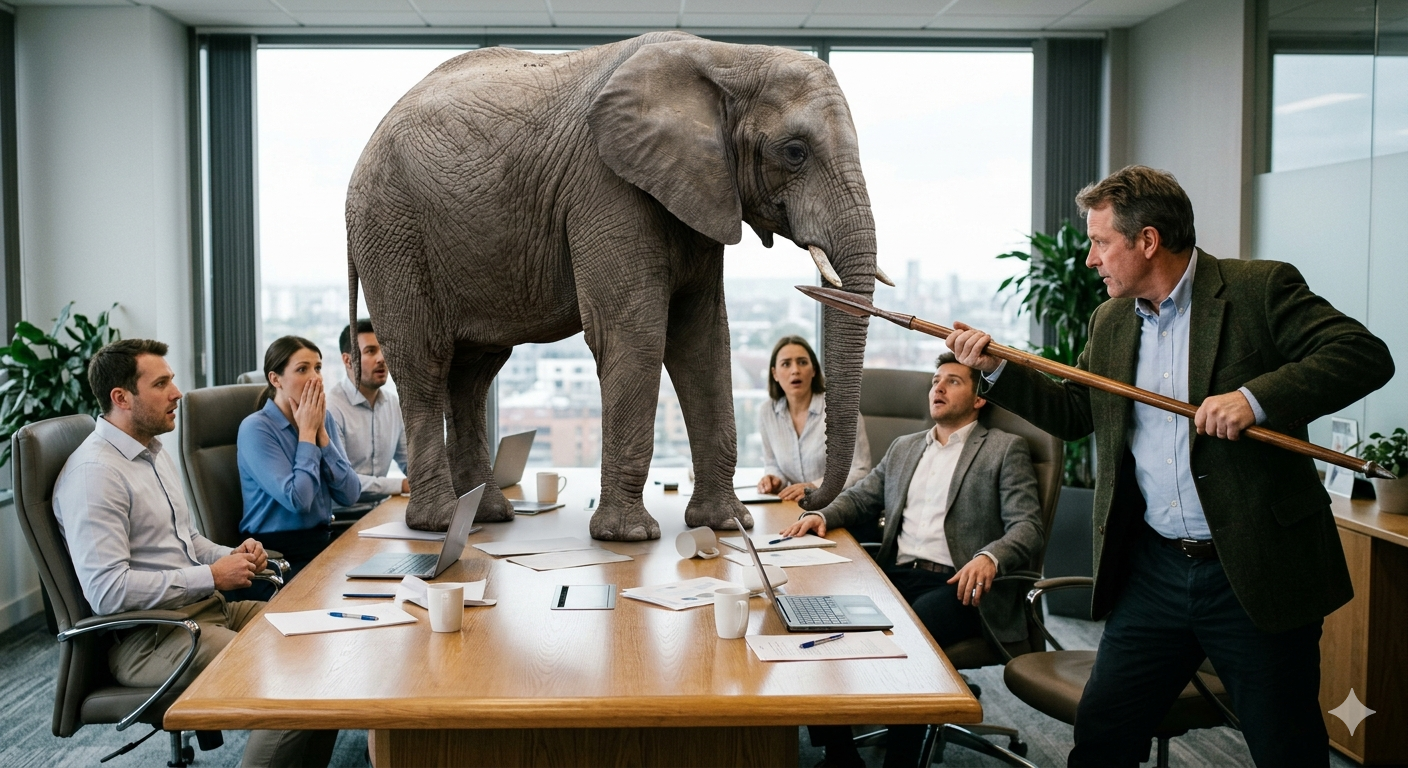
I thought I was keeping the peace, but I was actually managing a slow-motion wreck. I decided to stop being a caretaker and start being a hunter.
We have all sat in that meeting. The air is thick, the silence is heavy, and everyone is meticulously looking at their shoes or their laptops because a glaring problem just walked into the room. We call it “the elephant.” For years, I wasn’t just an observer of these creatures; I was their primary caretaker. I fed them with my silence, navigated around them with practiced agility, and prioritized the temperature of the room over the health of the organization. I thought I was keeping the peace, but I was actually managing a slow-motion wreck.
I eventually realized that a leader who ignores an elephant isn’t being “nice.” They are being complicit in the team’s stagnation. I decided to stop being a caretaker and start being a hunter.
The transition from caretaker to hunter begins with an honest look in the mirror. Most of us avoid the “hunt” not because we are lazy, but because we are trapped by the desire to be liked. I spent far too long in the “Popularity Trap,” trading my leadership integrity for a comfortable lunch table. I didn’t want to make enemies, and I certainly didn’t want to be the “difficult” one. Underneath that was an even deeper fear: the suspicion that if I started poking around the issues, I might find out that I was part of the problem. It is much easier to let a dysfunction live than to admit you might have helped raise it.
This avoidance often masks itself as “patience” or “empathy,” but we must call it what it really is: a lack of conviction. When a team lacks commitment, it’s rarely because they don’t want to work; it’s because the leader hasn’t made the mission worth the social bruises of a confrontation. To an unconvinced team, the elephant is just a permanent piece of furniture. They’ve learned to work around it because no one has shown them that the “hunt,” the difficult, messy conversation, leads to a level of freedom that far outweighs the temporary discomfort.
To move from fear to action, I developed what I call the “Calculus of the Hunt.” This isn’t about reckless aggression; it’s about a strategic trade-off. You must weigh the short-term damage of the hunt, hurt feelings, a spike in tension, or an unpredictable afternoon, against the long-term mission alignment and growth. When you realize that the elephant is the source of the friction, the waste, and the lack of motivation, the math changes. You begin to see that while the truth might cause a temporary blow-up, silence causes permanent rot.
The most liberating part of becoming a hunter is realizing that you don’t need a perfect solution to take the first shot. You don’t need a ten-step plan to fix the culture or the project before you mention it’s broken. In fact, identifying the elephant is fifty percent of the victory. When a leader has the courage to simply name the problem, it gives the rest of the team the “hunting license” to do the same. The discomfort that we all fear so much has a surprisingly low melting point. It is intense the moment the truth is spoken, but it begins to dissipate almost immediately as the team moves toward a resolution.
However, the hunter’s first rule is non-negotiable: you must clean your own office first. You cannot hunt a “lack of ownership” in your staff if you are feeding that very elephant through micro-management or unclear expectations. True hunting starts with a personal audit. It requires the humility to stand before your team and admit that you’ve allowed the issues to linger. That vulnerability is the spear that finally brings the elephant down.
The challenge now lies in your next forty-eight hours. Somewhere in your calendar, an elephant is waiting. You can feel it in the meeting you’re dreading or the email you keep staring at but won’t send. Run the calculus. Ask yourself if the mission is worth the temporary awkwardness of the truth. Stop feeding the dysfunction and start clearing the room. The air is too thin to keep living this way. It’s time to go hunting!